Archive

ZTRADER • RESEARCH

Deep Options 01: Why Being Right on Direction Is Often Not Enough

Here's what most options traders have done wrong.

Deep Options 01:  Why Being Right on Direction Is Often Not Enough
Deep Options 01: Why Being Right on Direction Is Often Not Enough

Deep Options 01:

Why Being Right on Direction Is Often Not Enough


Most people approach options with a stock trader’s mind.


They see a market view, translate that view into a call or a put, and assume the trade will work if the underlying moves in the expected direction. If they are bullish, they buy calls. If they are bearish, they buy puts. The logic feels clean, almost obvious. A call is a levered way to express upside. A put is a levered way to express downside. In theory, it sounds efficient.


In practice, this is where many options traders begin losing money.


Because an option is not just a directional instrument. It is a contract whose value is jointly determined by direction, time, and implied volatility. The underlying can move in the “correct” direction and the option can still fail to produce the payoff the trader expected. 

Sometimes the gain is much smaller than expected. Sometimes the option barely moves. Sometimes it even loses value after the market moves in the anticipated direction. To someone who still thinks like a stock trader, this feels irrational. It is not irrational at all. It is simply the options market pricing something different from what the trader thought he bought.


That difference is the first serious threshold in options thinking.


When you buy a stock, you are mostly buying directional exposure. When you buy an option, you are buying a package. Direction is only one component inside that package. You are also buying a certain amount of time, a certain amount of implied volatility, and a certain shape of payoff. If you do not know how much of the premium belongs to direction and how much belongs to volatility and time, then you do not really know what you are paying for. You may still place trades. Humans do that constantly, usually with confidence far exceeding their understanding. But you are not yet trading options in a professional sense.


This is why so many inexperienced traders have the same complaint after earnings, after CPI, after FOMC, or after some large macro headline. The market moves the way they expected, but their option does not perform the way they imagined. They feel cheated. In reality, they are encountering the core fact of the options market for the first time: the market had already priced a large move, and the option they bought was expensive before the event even happened.


This is the cleanest place to begin.


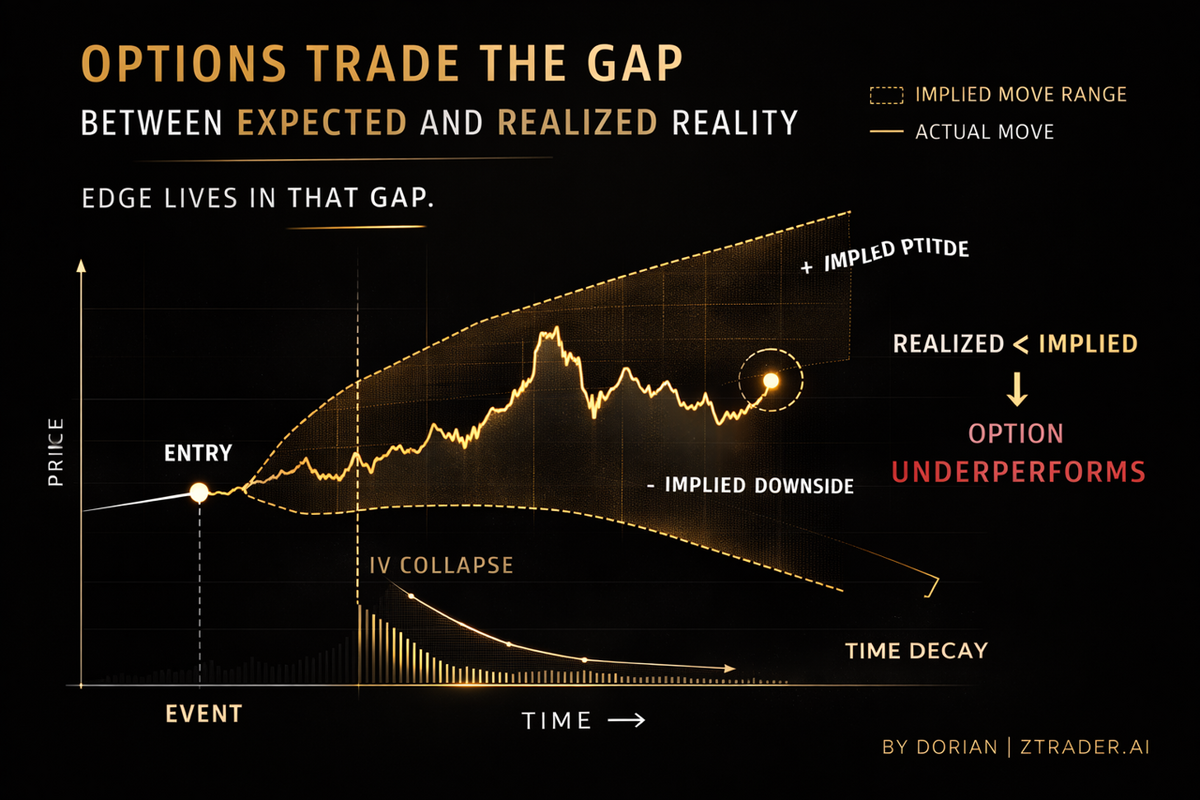
Suppose a stock is trading at 100. A trader expects a strong move higher after earnings and buys a near-dated 105 call. Earnings come out. The stock rallies to 107. On the surface, the trader was right. The direction was correct. The stock rose. But whether the trade was actually good depends on a different question: how much of that expected move had already been embedded in the option premium before earnings? If implied volatility was extremely high going into the event, then the option may have been pricing a move not of 7%, but perhaps 9% or 10%. After the event passes, the uncertainty collapses. Implied volatility drops sharply. Time value also shrinks because one major catalyst has been consumed. The trader was right on the sign of the move, but wrong on the pricing of uncertainty. That is why a “correct” directional call can still disappoint or even lose money.


This is the point most retail traders never fully internalize. They think they bought upside. What they actually bought was upside plus expensive event volatility plus rapid time decay. If the realized move does not exceed what was already implied, then being directionally correct is not enough.


That distinction matters because it changes the unit of analysis.


A novice asks, “Will the stock go up or down?”


A serious options trader asks, “How much movement is already priced, and is that pricing too cheap or too expensive relative to what is likely to happen?”


That is a completely different question. It is not a small refinement. It is a different game.


Once you start looking at options this way, you stop seeing them as directional lottery tickets and start seeing them as contracts on priced uncertainty. The underlying still matters, of course. But what matters just as much is the relationship between expected movement and implied movement. A trader can lose money not because his thesis was wrong, but because his forecast was not sufficiently different from what the options market had already assumed.


This is also why good stock traders often struggle when they first move into options. In cash equities, being roughly right can be enough. If you buy a stock at 100 and it rises to 107, you made money. The instrument is linear. In options, the same 7% move may produce a great result, a mediocre result, or a bad result depending on strike, tenor, implied volatility, and how much event premium was embedded beforehand. The instrument is not linear. The path into profit is narrower and more conditional. You are no longer trading the market’s direction alone. You are trading the gap between realized reality and priced expectation.


That sentence is worth holding on to:


an option trade is often a trade on the gap between realized reality and priced expectation.


This is why two traders can have the same market view and get very different outcomes. One buys short-dated naked calls into a crowded event when implied volatility is already inflated. The other expresses the same bullish view with a call spread or waits until after the event vol crush. Both are bullish. One is paying heavily for convexity and uncertainty. The other is controlling how much he overpays for that uncertainty. The first trader is trading opinion. The second is trading structure.


And structure is where professional options trading begins.


A professional is not impressed by “I think it goes up.” That opinion has almost no value by itself. The real questions are harder. How much upside is already priced? What part of the premium is pure volatility? How fast will that premium decay if the move comes late rather than immediately? Is this a situation where you want to own convexity, or a situation where you are overpaying for excitement that the market is already charging everyone for?


These are not decorative questions. They determine whether a trade has edge.


If you want to become genuinely good at options, one mental shift matters more than almost any Greek memorization exercise. Stop asking whether you are bullish or bearish first. Ask what the market has already charged for that possibility. In other words, stop treating options as amplified stocks. Start treating them as priced uncertainty.


That is the first doorway.


Cross it, and suddenly a lot of things that used to look random begin to make sense: why earnings buyers get punished, why expensive weekly options bleed so brutally, why a correct directional thesis can still be a bad trade, and why professionals spend so much time thinking about implied volatility and event pricing before they ever think about whether they “like” the story.


Because in options, being right is not the same as being paid.


You only get paid when reality exceeds the price already assigned to that reality.


That is where the craft starts.

logo2.jpg


Deepoptions01.png


Deepoptions02.png


Deepoptions03.png