Archive

ZTRADER • RESEARCH

Deep Options 02 The Most Expensive Thing Retail Traders Consistently Buy

Deep Options Trading 02

Deep Options 02 The Most Expensive Thing Retail Traders Consistently Buy


Deep Options 02
The Most Expensive Thing Retail Traders Consistently Buy


There is a very specific trade that almost every developing options trader makes at some point. The setup feels logical, almost irresistible. A major event is coming. Earnings. CPI. FOMC. A product launch. A legal ruling. Something that will obviously move price. The trader thinks: volatility is coming, therefore I should buy options.


What they do not realize is that this thought is already reflected in the price they are paying.


The market is not surprised that an event is coming. The options market is a forward pricing machine. It does not wait for uncertainty. It prices uncertainty in advance. By the time a retail trader notices that “something big is coming,” the options market has usually been adjusting for days or weeks. Implied volatility rises not because the event happened, but because the possibility of the event exists.


So what the trader thinks is anticipation is often just late participation.


This is why earnings trades feel so strange the first time someone really studies them. A stock can move strongly after results and the long option buyer still feels disappointed. The move happened. The narrative was right. But the payoff did not match the story in their head. That mismatch is not random. It is structural. They did not just buy direction. They bought volatility that had already been bid up by everyone else thinking the same thing.


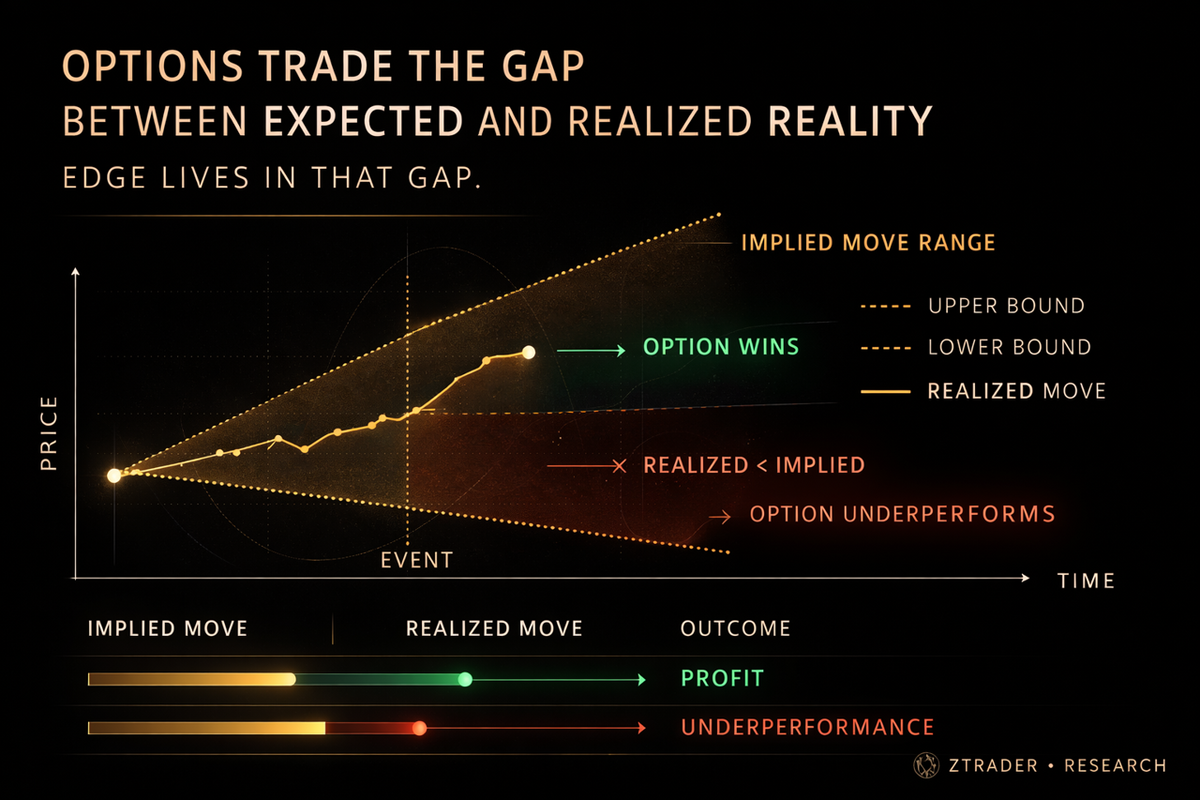
The real question in event trading is not whether a move will happen. The real question is whether the move will exceed what the options market has already priced as likely. That difference is everything. If a stock is expected to move five percent and it moves four, the trader who bought volatility still loses, even though the move may look large to someone watching the chart without context. If it moves six, then volatility buyers win. The trade is not about motion. It is about the relationship between motion and expectation.


This is the point where options thinking begins to diverge from narrative thinking.


Narrative thinking says: something important is happening.


Options thinking says: how much of that importance is already priced?


This distinction sounds small until you realize it explains why most event option buyers systematically transfer money to volatility sellers. They are not wrong about the presence of uncertainty. They are wrong about its price.


You can see this clearly if you look at implied volatility before and after earnings. Before the event, implied volatility climbs because the range of possible outcomes is still open. After the event, that uncertainty collapses instantly. Not gradually. Immediately. Even if the stock gaps up, the option can lose a major part of its premium because one of the things you paid for — uncertainty about what would happen — has now disappeared. Time did not just pass. A source of uncertainty was resolved.


This collapse is not punishment. It is just arithmetic.


Before earnings, the option price contains multiple components: the expected directional move, the probability distribution of surprises, and the simple fact that nobody yet knows the answer. After earnings, one of those variables disappears. The answer now exists. That alone removes a chunk of premium.


Many traders experience this as a betrayal. In reality, they are encountering the difference between trading stories and trading pricing.


The professionals who trade events rarely ask whether earnings will be good or bad first. That question matters, but it comes second. The first question is always: how expensive is the uncertainty around this event relative to how uncertain it actually is? Sometimes the right trade is to own volatility. Sometimes the right trade is to sell it. But the decision comes from pricing, not excitement.


This is also why experienced traders often structure event trades rather than simply buying naked options. If volatility is already expensive, they may use spreads to limit how much volatility they are paying for. If the market is pricing extreme movement, they may position for a move that is large but not extreme. If volatility looks underpriced, then owning convexity makes sense. The key difference is that they are not reacting to the event itself. They are reacting to the price of the event.


Retail traders tend to buy volatility because something feels important. Professionals buy volatility when it feels mispriced.


That sounds like a subtle distinction. It is not. It is the line between gambling on excitement and trading structure.


Another way to see this is to imagine two different earnings setups. In the first, the market expects chaos. Implied volatility is extremely elevated. Everyone is positioned for a violent move. In the second, expectations are quiet. Implied volatility is relatively subdued. Analysts expect little change. If a large move happens in the first case, it may still disappoint option buyers because so much was already priced. If the same move happens in the second case, option buyers can be paid dramatically because the market did not expect it.


Same move.
Different pricing.
Completely different outcome.


That is options trading in its simplest form.


Over time, traders who survive begin to realize that the question “will it move” is rarely enough. Markets move constantly. The better question is whether the market has already charged you for that movement. Once you start thinking this way, event trading becomes less about guessing the story and more about measuring the gap between implied movement and realistic movement.


That shift alone changes how you see almost every earnings trade.


Instead of asking whether you are bullish, you start asking whether volatility is overpriced. Instead of asking whether the company might surprise, you start asking whether the market is already assuming surprise. Instead of reacting to headlines, you start studying the implied move.


This is why many experienced options traders eventually stop treating earnings as directional trades at all. They treat them as volatility trades with a catalyst. Direction matters, but only relative to what was already embedded in the premium. Once you internalize that, the entire exercise becomes less emotional. You are no longer trying to be right about the story. You are trying to be right about the pricing of uncertainty around that story.


That is a quieter skill.


But it is the one that compounds.


Because over enough events, traders who consistently overpay for excitement tend to transfer money to traders who consistently measure what that excitement costs.


And that is the real pattern underneath most earnings option losses.


Not bad analysis.


Bad pricing awareness.


If there is one sentence that captures the professional approach to event options, it is this:


you are not trading the event, you are trading the price of the event.


Everything else follows from that.

deepoption06.png