ZTrader.AI Research · Macro Intelligence · June 6, 2026
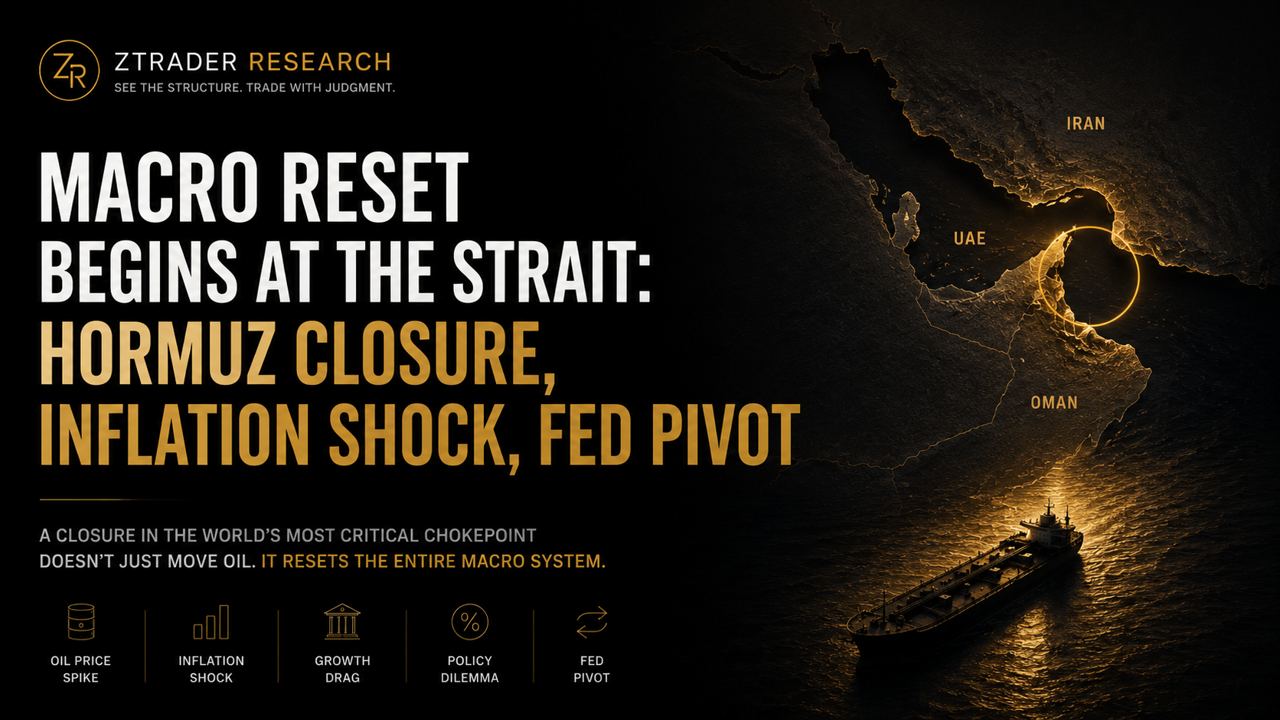
MACRO RESET
BEGINS AT THE STRAIT
Hormuz Closure · Inflation Shock · Fed Pivot
Insurance premiums don't lie.
When war risk rates for Hormuz transit spike 4,000%, the market is telling you something the headlines haven't caught up to yet. The buffer is burning. The inflation shock is delayed — not cancelled.

I. The Signal Nobody Is Reading
There is a data point that predates every oil futures move, every central bank statement, every CPI print. It is the war risk insurance premium for a ship transiting the Strait of Hormuz.
Before the Iran war began on February 28, 2026, that premium averaged 0.15% of a vessel's hull value per voyage — roughly $150,000 to $225,000 per transit for a large tanker.
Within weeks of the conflict's outbreak, Lloyd's List reported quotes as high as 5% to 10% of hull value. Bloomberg confirmed rates reaching 5% — five times the earliest wartime level, and a multiple of several dozen times the pre-war norm. At peak, some vessels faced premiums equivalent to a 4,000% increase. The Lloyd's Joint War Committee expanded its listed areas to cover the entire Persian Gulf.
That number is not a market indicator. It is a probability distribution maintained by underwriters with access to satellite imagery, naval positioning data, and geopolitical intelligence pipelines that no public terminal provides. When they reprice, they are repricing their estimate of a ship being lost. That is the most honest real-time signal the market has.
The Strait has been effectively closed for 94 days. Iran halted ceasefire talks on June 2 after Israel resumed strikes on Lebanon. The insurance market is not pricing a resolution.
War Risk Insurance Premium — Hormuz Transit% of vessel hull value per voyage · Source: Lloyd's List, Bloomberg 2026
II.The Buffer Arithmetic
Every major energy-importing economy has been drawing down strategic reserves since March. The math is now terminal.
Japan holds 230–240 days of oil stockpile — 146 days at national reserves, 88 days at private holdings. That sounds large. It is not large. Japan's refineries have already slashed utilization rates. The LNG buffer is structurally thinner: LNG cannot be stockpiled the way crude can, and Japan's Strategic Buffer LNG mechanism was not designed for a 94-day disruption.
The IEA coordinated its largest-ever emergency oil stock release beginning March 11 — 400 million barrels across 32 member countries, delivering approximately 2.5 million barrels per day over four months. As of May 8, 164 million barrels had already been deployed. The remaining buffer depletes around July 9. That is 33 days from today.
This is the number that reframes the entire market narrative: the IEA's May Oil Market Report projects a cumulative oil deficit of 900 million barrels by September 2026.
Even with the 400mb emergency release included, industry stocks face a 500mb shortfall. Rebuilding that deficit requires approximately 1 million barrels per day of surplus supply sustained for three consecutive years. That timetable assumes a June 2026 Hormuz reopening — which has not happened.
The EIA projects global oil inventories falling by an average of 8.5 million barrels per day through Q2 2026. 14.4 million barrels per day of Gulf output is currently below pre-war levels. Brent peaked at $144/barrel in mid-April before pulling back to $95 on ceasefire optimism as of June 5 — a $49 retreat that reflects hope, not physical reality. The physical market remains in structural deficit.
The most stressed economies are not Japan. Indonesia, Vietnam, Pakistan, and the Philippines are the first to hit critical supply levels. These are not abstract emerging market footnotes — they are production nodes in the global supply chain for electronics, textiles, and food.
China holds the largest strategic reserve at 1.4 billion barrels, exceeding the combined reserves of the US, Japan, OECD Europe, and Saudi Arabia. China's restraint in drawing down has provided a stabilizing floor. But that restraint has a limit shaped by domestic incentives, not multilateral generosity.
III.The Lag Structure of the Inflation Shock
This is where most macro analysts are making the error.
Inflation has not spiked. Therefore, some conclude, the energy shock is being absorbed. This is wrong. What is happening is that the buffer is being consumed. The inflation spike is not prevented — it is delayed. The mechanism is straightforward: as long as refineries are processing stockpiled crude, domestic prices are insulated. The moment stockpiles reach critical threshold, that insulation ends. Supply drops, spot prices transmit instantly to consumer prices, and the CPI print that follows reflects a supply event that was visible 60–90 days earlier to anyone watching insurance premiums and inventory drawdown rates.
The IEA buffer depletes around July 9. Private and national reserves across Asia start hitting threshold levels in late July to early August. The inflation print reflecting that inflection will appear in September CPI data, released in October.
The Fed is currently watching lagged data. PCE is still running elevated. The labor market printed 172,000 jobs in May with unemployment unchanged at 4.3%. Jerome Powell cannot cut into this backdrop. But he also cannot hike preemptively on an energy shock that hasn't yet appeared in the data. The Fed is structurally behind.
There is a second-order effect that is underpriced: the petrochemical and aviation sectors are already in distress. The IEA reports LPG and naphtha supplies have collapsed across Asia as Gulf feedstock dried up. Aviation is running well below normal levels. These are not energy-CPI inputs — they are production cost inputs. The inflation channel is not just gasoline prices at the pump. It runs through plastics, packaging, fertilizers, and every manufactured good with a petrochemical input chain.
IV.The Forced Pivot
When the September CPI print arrives in October with energy-driven inflation acceleration, the Fed's reaction function becomes binary.
Option one: ignore the energy component, treat it as transitory, hold rates.
This destroys credibility. The Fed already spent credibility capital in 2021–2022 calling supply-side inflation transitory. A repeat would be catastrophic to the yield curve. Markets would price in a Fed that has permanently lost the ability to anchor expectations.
Option two: hike. One, possibly two 25bps moves by Q4 2026, with forward guidance signaling more.
This reprices everything. Dollar strengthens. Carry trades unwind — the yen carry in particular, which has been under structural pressure from JGB anchor dynamics all year. Crypto gets hit again because funding costs spike and leveraged long positions face forced liquidation. Equities rerate on higher discount rates.
The S&P is already showing weakening spot momentum. VIX is currently cheap — compressed below where it should be given the geopolitical and liquidity backdrop. Bitcoin has collapsed from $126,000 in October 2025 to the $61,000–$64,000 range, with ETF outflows totaling over $4.2 billion in three weeks. On-chain LTH SOPR fell below 1.0 — long-term holders selling at a loss, a classic capitulation signature. The crypto deleveraging is not noise. It is the leading edge of the broader liquidity drain.
V.The Sequence
The thesis in compressed form:
The Cascade Sequence — Timeline to Macro Reset
Signal chain from Hormuz to Fed pivot · ZTrader.AI thesis
The macro reset does not begin with the Fed announcement. It began at the Strait. Everything else is the echo.
The data that matters is not in the terminal. It is in the Lloyd's war risk quotes, the IEA inventory drawdown rate, and the 14.4 million barrels per day of Gulf output that has not moved through the Strait in 94 days.