0. Why This Article Exists
People don’t understand options because Wall Street loves keeping things unnecessarily complicated.
They drown you in Greeks, PDEs, stochastic calculus, and pretend that buying a call is some metaphysical ritual.
It’s not.
Options are painfully simple once you view them through the correct lens:
Option Buyer = Buying Lottery Tickets / Paying Insurance / Making a Deposit
Option Seller = Selling Insurance / Running the Casino / Collecting Premium
This single framing already explains 70% of the entire derivatives industry.
The remaining 30% is just pricing, volatility, and behavior.
So this article will do three things:
- Explain options using analogies normal humans understand
- Show how the payoff structure mirrors insurance and casinos
- Build a solid foundation to make you a dangerous options trader, not a gambler
If you’re tired of useless financial influencers, here’s the only “real” intro you need.
1. What an Option Really Is (Forget Textbooks Forever)
Let’s remove all jargon and say it in one sentence:
An option is a contract that gives you a choice in the future,
and that choice costs a fee today.
The easiest metaphor:
1.1 Buying an option = Paying a deposit
You put $200 down to reserve a house.
If the house rises from $500,000 → $600,000,
you execute the right and buy it at the cheaper price.
If the market collapses to $450,000,
you walk away and only lose your deposit.
That deposit
= Option Premium
= Your Maximum Loss
Simple.
1.2 Selling an option = Taking someone’s deposit
If you are the house owner, you’re saying:
“I’ll let you buy at $500k later, but give me $200 now.”
If prices go up, the buyer can take advantage of you.
If prices go down, the buyer walks away and you keep the $200.
This is literally option selling.
You collect premium and take the other side of market risk.
Congratulations.
You now understand the core logic better than half the CFA candidates.
2. Buying Options = Buying Insurance or Lottery Tickets
This is the part people misunderstand the most.
2.1 Buying a Call = Buying a lottery ticket that pays when price goes UP
You pay a small amount for a chance at a huge gain.
Limited loss.
Unlimited upside.
This is why calls feel like “lottery tickets”…
except unlike the real lottery, your odds can actually be rational.
2.2 Buying a Put = Buying downside insurance
You protect your portfolio:
- Own Tesla?
- Buy a put.
- Own Bitcoin?
- Buy a put.
- Long S&P?
- Buy a put.
If price collapses, your put offsets losses.
A Put = Fire insurance for your assets.
Nobody calls buying insurance “gambling”.
Yet buying puts is constantly framed as speculation.
Amazing how financial language manipulates perception.
2.3 Why buyers consistently lose money
Because buyers are:
- paying for time
- paying for volatility
- paying for convenience
- paying for an asymmetric return profile
And the casino (market) always takes its cut.
Buying options is not inherently wrong.
But it must be done correctly:
trend + volatility timing + right maturity + right strike.
3. Selling Options = Running a Casino
Now we get to the dark arts.
Option sellers, whether retail or market makers, operate like insurers:
- They collect premiums
- They expect most contracts not to be exercised
- They rely on predictable risk distribution
- They win small amounts frequently
- They blow up spectacularly if careless
3.1 Selling Calls = Selling upside insurance
You basically tell the buyer:
“If price goes to the moon, I’ll pay you.
If not, I keep your premium.”
You sound like an insurance company.
3.2 Selling Puts = Selling downside insurance
This is literally what institutional insurers and pension funds do:
- They sell puts on equities
- They collect premium
- They assume long-term markets trend up
- They pocket income consistently
It’s boring.
It makes money.
Until it doesn’t.
(See: 2008, 2020, 2022…)
4. The Real Reason Options Exist
Let me tell you a truth nobody likes hearing:
Options exist because someone needs insurance
and someone else wants to collect premiums.
Everything else — volatility surfaces, Black–Scholes, Greeks — is just plumbing.
4.1 Hedgers
These guys NEED options:
- Funds hedging downside
- Corporations hedging FX
- Miners hedging commodities
- Banks hedging structured products
They’re not gambling.
They’re reducing risk.
4.2 Speculators
These guys WANT options:
- Momentum traders
- Gamma scalpers
- Vol traders
- Directional gamblers
They love leverage.
4.3 Market Makers
These guys CANNOT avoid options:
- They provide liquidity
- They constantly hedge
- They delta-neutral
- They profit from the spread and premium decay
They are the casino with enough capital to survive.
5. The Four Foundational Payoff Diagrams (Explained Properly)
You’ve seen those cute slanted lines, but here’s what they actually mean.
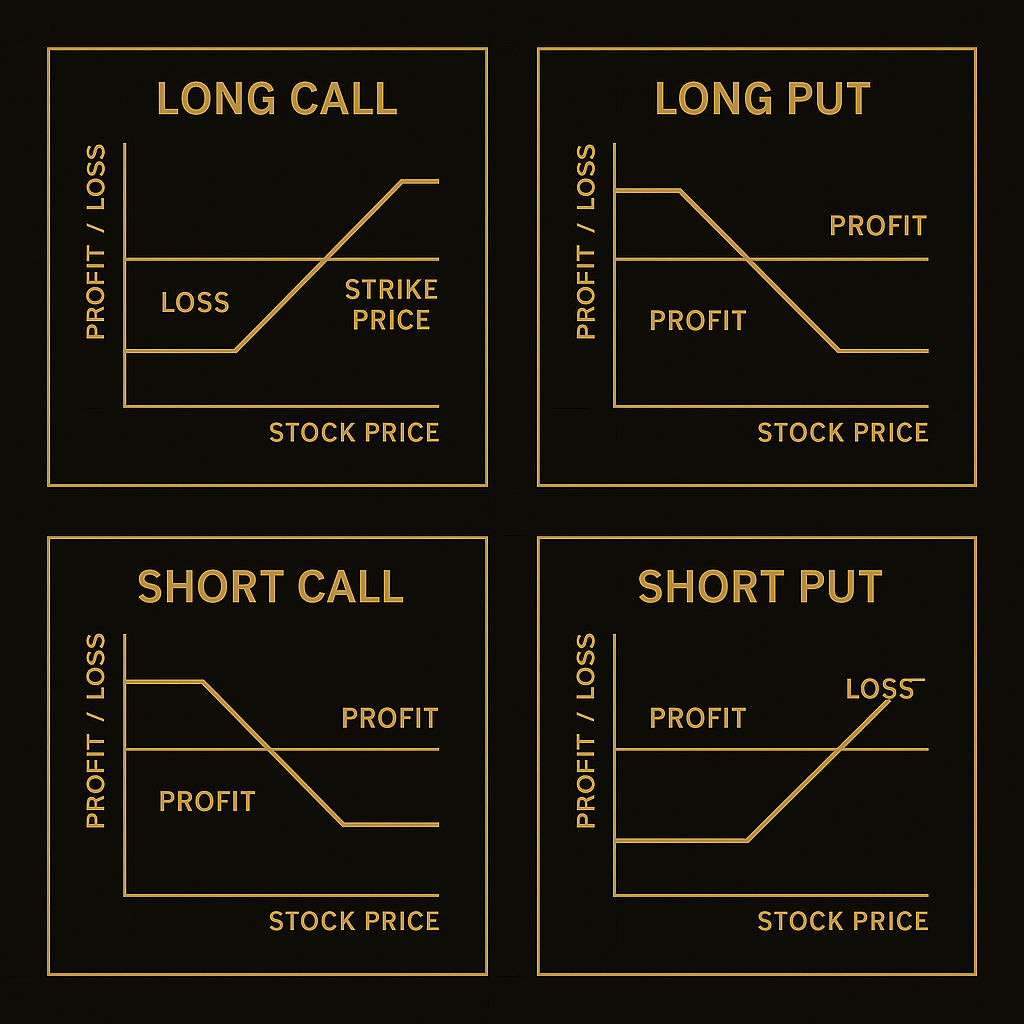
5.1 Long Call = Your House Deposit Analogy
- Limited loss (premium)
- Unlimited upside
- Time decay is your enemy
- Volatility expansion is your friend
5.2 Long Put = Your Portfolio Insurance
- Limited loss
- Explosive gain in crisis
- Volatility spikes → huge profits
- Best in bear markets or uncertainty
5.3 Short Call = You’re the Insurance Seller
- Small, consistent profits
- Risk of catastrophic unlimited loss
- Good in low-volatility, range-bound markets
5.4 Short Put = You Run the Casino
- Collect premium regularly
- Assigned only if price collapses
- Risk is large but capped (asset goes to zero)
- Strategy of professionals to acquire stock cheaper
You want the truth?
Short puts = The most used strategy by actual hedge funds and institutions.
They’re not buying YOLO calls like Reddit degenerates.
6. Why Most Retail Traders Lose With Options
Not because options are bad.
Because retail trades them with zero structure.
6.1 99.9% of retail traders use options for direction only
Options are about:
- timing
- volatility
- decay
- liquidity
- skew
Direction is only 20% of the equation.
6.2 They buy short-dated options
This is basically a tax paid to market makers.
6.3 They misunderstand volatility
IV crush destroys beginners.
6.4 They don’t hedge
Option buyers need hedging more than stock buyers.
6.5 They don’t understand position sizing
A $5000 account shouldn’t be blowing $1500 on weekly options.
Retail is not dumb — they are mis-educated.
7. The True Foundation of Option Trading
Everything we discuss later — Greeks, IV, Gamma — rests on this foundation:
Options = Insurance + Time + Volatility
Buyers pay for convexity
Sellers get paid for linearity
If you internalize this, then:
- you’ll know when to buy options
- you’ll know when to sell options
- you’ll stop gambling
- you’ll start thinking like a math-driven trader
- you’ll understand hedge fund behavior instantly
8. The Correct Mental Model (The One That Actually Makes You Money)
8.1 As a Buyer
You want:
- Trend
- Momentum
- Volatility to rise
- Enough time
- Precise strike selection
Buying options is an offensive weapon.
8.2 As a Seller
You want:
- Sideways markets
- Falling volatility
- Time decay
- Range-bound behavior
- Strong capital base
Selling options is a defensive cash-flow machine.
8.3 As a Professional
You use both, systematically.
The smartest traders never marry one side.
They rotate between buying and selling depending on volatility regimes.
9. Practical Framework for Newcomers
Here’s the cleanest possible starter framework:
Buy Calls when:
- Uptrend confirmed (SMA20 > SMA50)
- IV is low
- Catalyst incoming
- Time to expiry ≥ 20 days
Buy Puts when:
- Downtrend confirmed
- IV moderate
- Market fear rising
- Portfolio hedging needed
Sell Puts when:
- You want to accumulate stock cheaper
- Market is stable
- IV is elevated
You have enough collateral
Sell Calls when:
- Market is flat
- Volatility high
- You want premiums on existing stock
10. The Single Best Sentence That Explains Options
Here it is — the one line that replaces 500-page textbooks:
Options are a negotiation between certainty and possibility,
where one side pays for asymmetry,
and the other side profits from probability.