
Most investors think of options trading as “extremely complicated” or full of intimidating “math-vibes.”
But that’s simply not true.
In reality, options can be incredibly intuitive — if you approach them with caution and a willingness to learn.
In fact, trading options is very much like learning how to drive a car.
Everyone knows driving can be both empowering and dangerous.
Options share the same duality: profitable when handled well, disastrous when ignored.
The good news?
Unlike driving, blowing up an options trade won’t kill you — only your account.
So let’s extend the driving analogy.
When you first learn to drive, you master only the basics:
accelerate and brake.
That’s the options equivalent of learning calls and puts — simple inputs with predictable effects.
Press the gas → move forward (upside).
Hit the brake → slow down (downside protection).
Basic, direct, easy to grasp.
But no one becomes a real driver by only pressing pedals.
Now, what about the Options Greeks?
Think about your car’s dashboard.
Speedometer, fuel gauge, temperature, oil pressure, engine load, warning lights —
all the subtle signals telling you how the machine is behaving beneath the surface.
That is exactly what the Greeks are.
They are not math equations.
They are feedback systems.
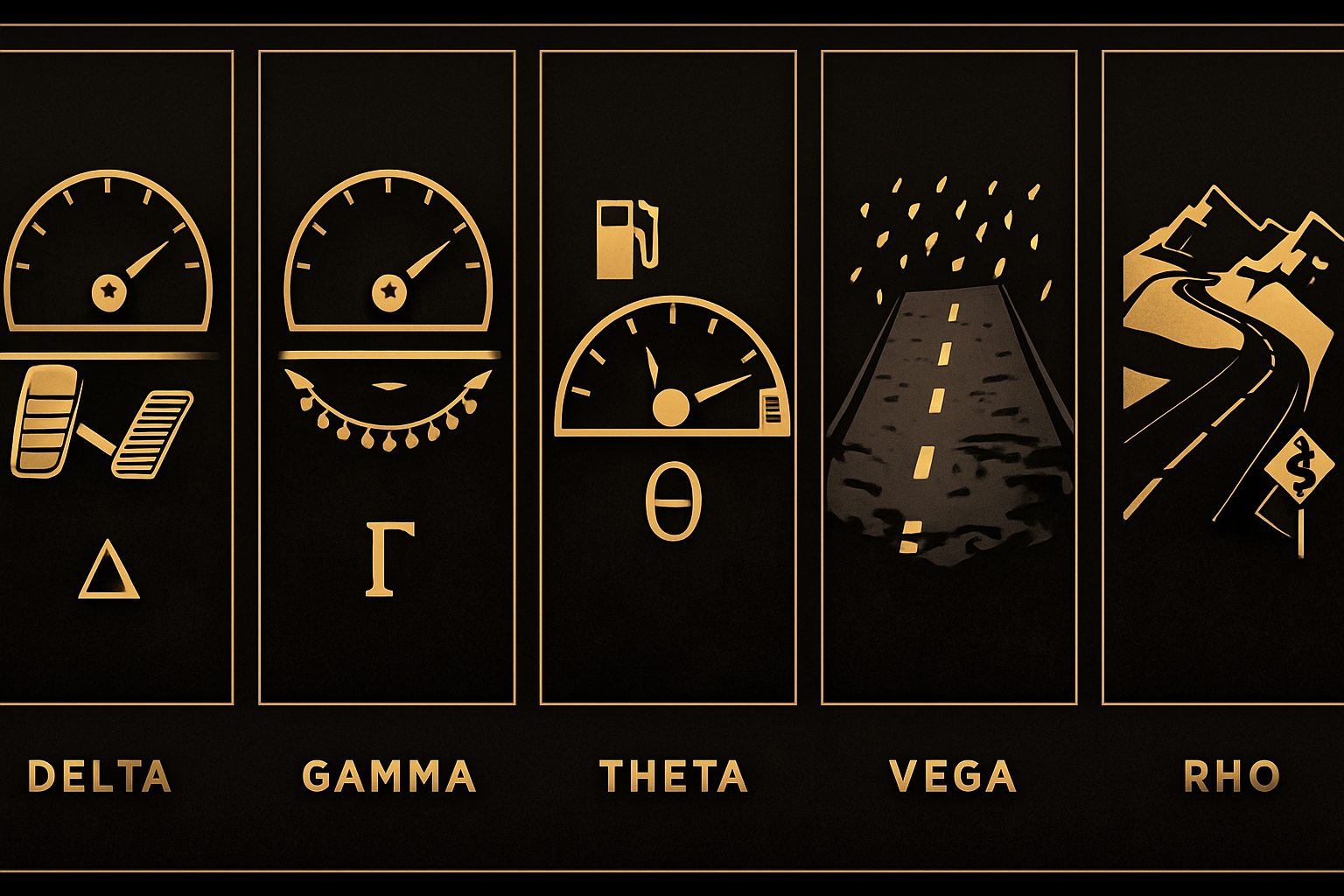
To become a safe and skilled driver — or a competent options trader — you must learn to:
• Control your maximum speed → Delta
Delta tells you how quickly your position moves relative to the underlying.
Higher delta = faster speed, stronger directional exposure.
• Carefully monitor your acceleration → Gamma
Gamma tells you how fast your “speed” (delta) can change.
High gamma is like a car that jerks forward with tiny touches on the pedal — exciting, but dangerous.
• Watch your fuel consumption → Theta
Theta measures how quickly you “burn fuel” (lose value) over time.
Even parked cars burn fuel.
So do long options.
• Pay attention to road conditions → Vega
Volatility is weather.
Vega tells you how sensitive your car is to changing road surfaces —
dry, wet, slippery, foggy, stormy.
• Understand the slope of the terrain → Rho
Interest rates tilt the entire road slightly uphill or downhill.
Not noticeable on short trips, but vital on long journeys.
Why this matters
Anyone can push a pedal.
Anyone can buy a call or put.
But real mastery comes from reading the dashboard —
understanding how the machine is responding in real time.
Options aren’t about guessing where price goes.
They are about controlling:
- speed
- acceleration
- traction
- time decay
- volatility climate
- hidden forces acting on your vehicle
Once you see options through this driving model,
the entire subject becomes intuitive, even elegant.
A car is a machine of signals, tension, stability, and feedback loops.
And so is an options position.
Here’s the easy way to understand how option greeks really work:
Calls and puts are the pedals.
Greeks are the dashboard.
Volatility is the weather.
Liquidity is the road surface.
Dealer gamma is the stability control system beneath you.
Hedging is steering.
Tail risk is centrifugal force in a tight turn.
The volatility surface is the entire terrain map — hills, valleys, slopes, unseen corners.
Now let’s talk about the car.
1. The Car: Your Options Position
Your option position is not an instrument — it’s a vehicle.
- A long call is a sports car: fast, responsive, exciting, easy to lose control.
- A long put is a defensive vehicle with emergency brakes.
- A short option position is a truck carrying dangerous cargo — powerful, profitable, but deadly when mishandled.
- A spread is a car with modified suspension: safer, more controlled, less explosive.
- A volatility trade is a rally car designed for unpredictable terrain.
This car can take you anywhere —
but only if you know how to control it.
2. The Pedals: Calls and Puts
These are the basics: forward and back, gas and brake.
- Pressing the call pedal gives you acceleration toward upside.
- Pressing the put pedal gives you acceleration toward downside protection.
But like driving, pressing pedals without knowing the mechanics underneath is textbook suicide.
Retail traders think pedals are enough.
Professionals know pedals merely trigger the system.
They don’t control it.
Real Control comes from KNOWING the dashboard.
3. The Dashboard: The Greeks
When you truly learn options, you stop trading price and start reading signals.
Every Greek is a gauge measuring a critical dynamic of your “machine.”
3.1 Delta — The Speedometer
Delta tells you how fast your position is moving relative to the underlying.
- Δ = 1 → you’re effectively driving 100% stock.
- Δ = 0.5 → half speed.
- Δ ≈ 0 → you’re pressing pedals but car barely moves.
New traders drive purely by speed.
Professionals check speed relative to terrain and weather.
3.2 Gamma — The Acceleration Gauge
Gamma shows how quickly your speed (delta) changes.
It is the most dangerous gauge.
- High gamma = your “car” reacts explosively to small movements.
- Low gamma = stable driving.
- Short gamma = driving with over-sensitive steering on an icy road.
If delta is speed, gamma is the rate of change of speed.
This is where accidents happen.
Every blowup story starts with ignored gamma.
3.3 Theta — The Fuel Gauge (But It Always Drops)
Theta is the only gauge that always moves in one direction: down.
Your fuel is burning with every hour, every minute.
Whether you move or not.
- Long options = your fuel tank drains faster as expiration nears.
- Short options = you collect fuel from others burning theirs.
The cruel truth:
Time doesn’t care about your strategy, your conviction, or your emotions.
They all end up WORTHLESS = ZERO
THEREFORE, Theta is the silent killer.
3.4 Vega — The Weather Indicator (Visibility & Storms)
Vega tells you what happens when the weather changes — when volatility shifts.
- Clear weather → low vol → safe driving
- Fog / rain → high vol → reduced visibility and unpredictable moves
- Storm → vol spike → panic braking by all market participants
A vega-heavy trade is like driving a sensitive car in a place where weather changes violently.
You might think price will go your way.
But if volatility collapses?
Your car loses ALL POWER instantly.
3.5 Rho — The Terrain Slope (Interest Rate Gradient)
Rho is the uphill/downhill slope caused by interest rates.
- High rates = uphill for puts, downhill for calls
- Low rates = flat terrain
In most circumstances, you won’t notice how Rho changes on short trips.
But on long journeys?
It defines the entire landscape.
4. The Road: Market Liquidity
Liquidity determines how smooth your path is.
- High liquidity = paved highway
- Low liquidity = gravel road
- No liquidity = mud in the rain
A perfect options strategy executed on a dead market is like racing a Ferrari in a swamp.
Professionals always check the road before stepping on the gas.
5. The Weather: Volatility Regime
Volatility is not a number.
It’s a climate system.
- Low vol regime = calm skies
- Medium vol regime = shifting winds
- High vol regime = storms
- Volatility-of-volatility = how unpredictable the storms are
Options pricing is meteorology.
Not arithmetic.
6. The Car’s Hidden System: Dealer Gamma & Vol Flow
You think you’re steering.
But the car has an automatic stability system underneath — dealer hedging flows.
- When dealers are long gamma → the car self-stabilizes; every swerve is corrected.
- When dealers are short gamma → the car amplifies every movement; tiny turns become spins.
This is why markets sometimes feel:
- impossibly calm
- or unreasonably violent
It’s not “psychology.”
It’s engineering.
7. Steering: Hedging
Hedging is steering correction.
Every options position drifts as Greeks decay and volatility shifts.
Professionals hedge every time the car drifts.
Retail traders hold the wheel straight and hope the road stays flat.
This is why retail dies in storms.
8. The Terrain Map: The Volatility Surface
The vol surface is the full topographic map of the road ahead:
- Skew = slope
- Smile = curvature
- Term structure = different terrains across time
- Surface deformation = shifting sand beneath your tires
Most traders don’t know the map exists.
Professionals navigate using it.
9. The Real Reason This Model Works
Because options are not about prediction.
They are about controlling motion:
- speed
- acceleration
- drift
- traction
- visibility
- terrain
- time
- hidden forces acting on you
Everything the Greeks measure is simply the machine telling you:
“If you continue like this, the car will do that.”
As Professional Traders, always remember this.