A Volatility Risk Input Document
Editorial Notice
This is a judgment and risk-input document.
It does not provide trade recommendations, signals, or forecasts.
Its purpose is to clarify how volatility behaves under structural stress, how so-called “black swan strategies” actually function at the institutional level, and how volatility exposure should be evaluated as a system of defense rather than a directional bet.
I. Volatility Is Not Fear: Correcting the First Structural Error
The VIX is commonly described as a “fear index.”
This description is not merely inaccurate—it is operationally misleading.
Fear is psychological.
Volatility is contractual.
The VIX represents the market-implied expectation of variance over the next 30 days, derived from a strip of S&P 500 index options. It reflects how option sellers price uncertainty, not how investors emotionally respond to news.
This distinction matters because:
Emotions do not clear markets
Contracts do
Constraints propagate faster than sentiment
Markets do not crash because fear appears.
Fear appears because market structures fail to absorb risk smoothly.
Understanding volatility begins by abandoning emotional metaphors.
II. What a “Black Swan” Actually Represents in Markets
In popular usage, any large price movement is labeled a black swan.
In professional risk frameworks, this is incorrect.
A true black swan is not defined by magnitude, but by structural discontinuity:
Correlations converge unexpectedly
Liquidity vanishes non-linearly
Time compresses faster than portfolios can rebalance
Most volatility events are not surprises.
They are accelerations.
The 2008 crisis, the March 2020 crash, and the 2022 bond-equity drawdown all exhibited advance signals in:
Credit spreads
Funding markets
Option skew
Volatility term structure
What failed was not awareness, but reaction speed.
Black swans are therefore not about ignorance.
They are about insufficient convexity under stress.
III. Deconstructing the VIX: Spot, Futures, Structure, and Skew
Treating the VIX as a single number is a category error.
1. Spot VIX
A non-tradable index reflecting current option pricing.
Spot spikes are outputs, not inputs.
2. VIX Futures
Tradable instruments embedding expectations of future volatility.
They are subject to:
Roll yield
Carry decay
Dealer hedging flows
Most retail losses in volatility occur here.
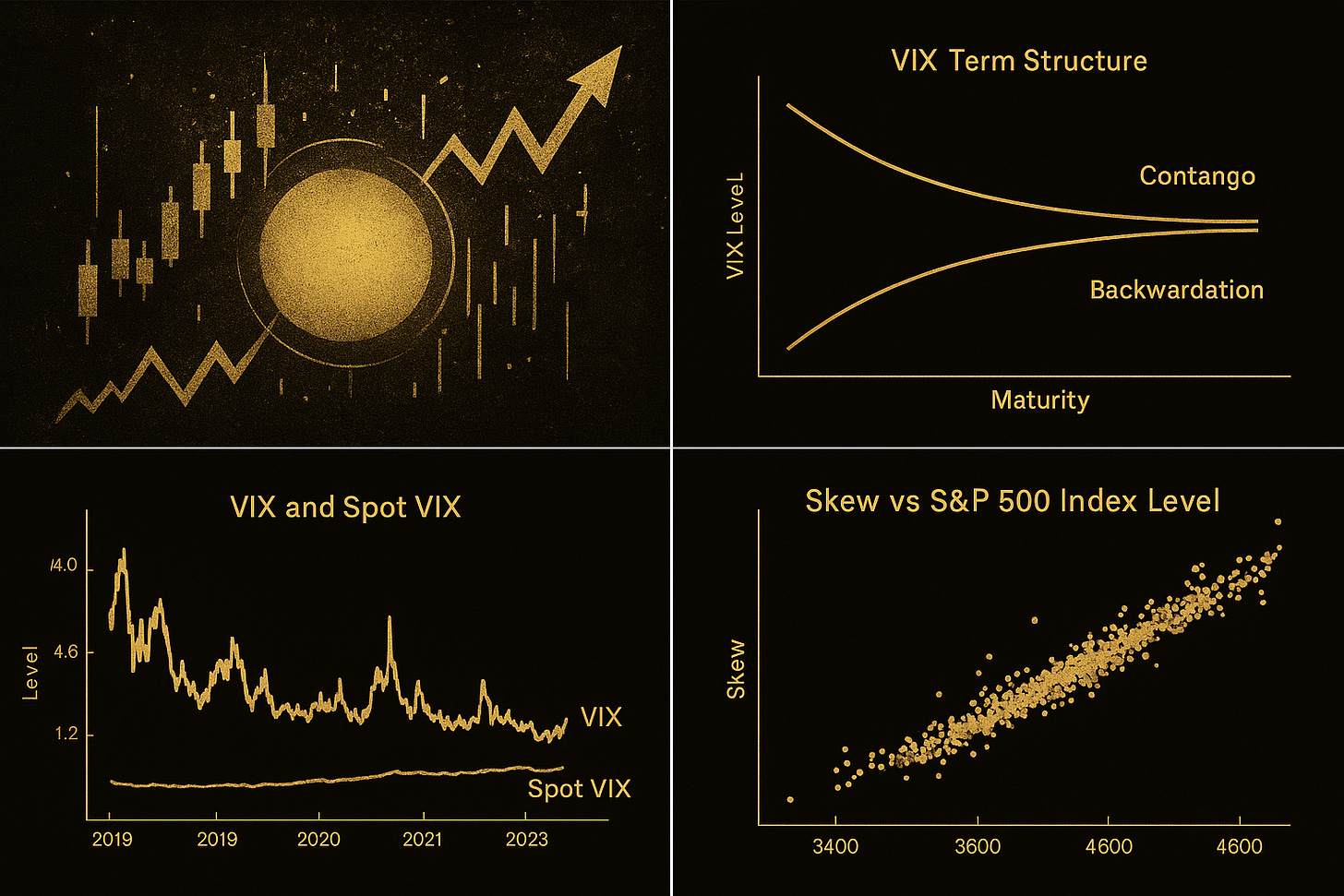
3. Term Structure
In stable markets, VIX futures are in contango.
During stress, they shift to backwardation.
This inversion signals immediate demand for protection and often coincides with balance-sheet pressure at institutions.
4. Skew
Skew measures asymmetric demand for downside protection.
Rising skew with stable VIX often precedes volatility events.
It reflects insurance demand, not panic.
IV. Why Long-Volatility Strategies Lose Money by Default
A persistent misconception holds that long volatility must be profitable because crises inevitably occur.
This ignores the structural reality:
Volatility carries a persistent risk premium
Option sellers are compensated for providing insurance
Most of the time, realized volatility < implied volatility
Volatility is expensive because it protects against rare but severe outcomes.
Naïve long-vol positions fail because:
Carry costs accumulate
Timing uncertainty dominates
Path dependency erodes capital
This is not a flaw of markets.
It is the price of insurance.
V. Institutional Volatility Use: Defense, Not Conviction
Institutions do not trade volatility to express opinions.
They use it to:
Stabilize portfolio convexity
Protect liquidity under stress
Offset correlation breakdowns
Reduce catastrophic regret
Volatility overlays are evaluated at the portfolio level, not trade by trade.
A strategy that loses small amounts for years may still be optimal if it prevents forced liquidation during systemic events.
Retail frameworks often fail because they isolate trades rather than systems.
VI. The Anatomy of a Legitimate Black Swan Strategy
A valid tail-risk framework shares four properties:
1. Accepted Carry Loss
Persistent cost is not a bug; it is the fee for protection.
2. Small, Durable Sizing
Exposure must be survivable across extended calm periods.
3. Conditional Adjustment
Positions are adjusted based on structural signals, not forecasts.
4. Survival Priority
Precision is secondary to endurance.
Black swan strategies are judged by resilience, not hit rate.
VII. Path Dependency: The Silent Killer of Volatility Trades
Most volatility strategies fail even when “correct” due to path dependency.
Interim drawdowns, roll decay, and psychological pressure force premature exit.
This is why institutions favor:
Long-dated options
Structured spreads
Low leverage
The challenge is not identifying risk.
It is staying solvent until risk materializes.
VIII. Liquidity as the True Volatility Trigger
Market crises are liquidity events first, price events second.
Volatility spikes when:
Market makers reduce balance-sheet usage
Bid-ask spreads widen abruptly
Hedging becomes reflexive
In these moments, volatility becomes a constraint, not a price.
This reframes volatility trading as a study of market capacity, not sentiment.
IX. Common Retail Misconceptions About Black Swan Trading
Treating volatility as directional
Overusing leverage
Ignoring term structure
Expecting immediacy
Confusing macro narratives with option mechanics
These errors are structural, not intellectual.
X. When This Document Should Be Used
This article is intended as a reference when:
Volatility appears suppressed
Correlations feel unstable
Hedging costs seem unjustified
Risk appetite exceeds structural support
It exists to limit incorrect behavior, not to prompt action.
XI. Final Risk Input
Volatility does not reward conviction.
It rewards preparation.
Black swans are not hunted.
They are survived.
The VIX is not a weapon.
It is a diagnostic instrument.
Appendix A — Volatility Strategy Taxonomy (Non-Executable)
1. Tail Insurance Frameworks
Long-dated OTM index puts
Calendar-based convexity
Purpose: catastrophic drawdown mitigation
2. Regime-Shift Awareness
Indicators often monitored:
VIX term structure flattening
Rising skew
Credit spread widening
Funding stress metrics
Purpose: conditional adjustment, not prediction
3. Structural Volatility Exposure
Ratio spreads
Time-diversified hedges
Purpose: reduce path dependency
4. Evaluation Metrics (Non-P&L)
Maximum drawdown reduction
Portfolio variance under stress
Liquidity survival metrics
Closing Note
This document is designed to be returned to, not consumed once.
If it prevents even a single structurally incorrect decision during stress, it has served its purpose.
